Views: 0 Author: Site Editor Publish Time: 2026-09-15 Origin: Site
Material selection for minimally invasive medical devices requires exact engineering. When you deploy a component inside the human vascular system, it must work perfectly every time. Engineers constantly balance maximum compressibility for catheter delivery, high fatigue resistance for long-term implantation, and scalable manufacturability on the shop floor. Sourcing raw materials means looking past basic dimensions and generic data sheets. You need a systematic framework to evaluate specifications. This involves assessing alloy composition, processing history, and structural tolerances to meet strict FDA and MDR compliance. Moving from a conceptual design to a mass-produced medical device requires understanding how the starting material behaves under extreme thermomechanical stress. We will break down how to specify the right tubing for your application, ensuring your final device hits all performance metrics without failing during downstream manufacturing steps.
Application Dictates Tube Type: The choice between standard nitinol hypotube and custom precision tubing depends entirely on the device's fatigue requirements and feature sizes (e.g., delivery catheters vs. neurovascular stents).
Transformation Temperature (Af) is Critical: Specifying the correct Active Austenitic Finish (Af) temperature ensures the nitinol tube exhibits the required superelasticity at human body temperature (37°C).
Strategic Sizing Maximizes Performance: Starting with a strategically smaller nitinol tube allows engineers to leverage the material's unique properties for extreme expansion rates and superior bending capabilities in the final device.
Surface Finish Impacts Biocompatibility: The state of the tube's surface (oxide layer vs. electropolished) directly influences corrosion resistance and nickel leaching, which are critical for regulatory approval.
Processing Realities Determine Yield: Factoring in downstream processes like laser cutting, shape setting, and the tube's origin (from rod to drawn tube) mitigates micro-cracking and material fatigue risks.
Table of Contents
Medical devices require precise thermal and mechanical behavior. Superelastic Nitinol is commonly used in self-expanding stents, heart valve frames, and guidewires, allowing devices to be compressed for delivery and recover their shape after release while maintaining outward force.
Shape memory Nitinol remains deformed at lower temperatures and returns to its programmed shape when heated, such as at body temperature. Selecting the correct phase behavior at 37°C is therefore critical to ensure proper deployment, radial force, and long-term device performance.
Material Behavior | Phase at Room Temp (22°C) | Phase at Body Temp (37°C) | Common Medical Applications |
|---|---|---|---|
Superelasticity | Austenite | Austenite (transforms under stress) | Self-expanding stents, heart valve frames, guidewires |
Shape Memory | Martensite | Austenite (recovers shape upon heating) | Orthopedic staples, orthodontic archwires, specialized actuators |
High-fatigue medical devices such as TAVR frames and peripheral stents must withstand millions of loading cycles, making material quality critical. Microscopic inclusions, voids, or drawing defects can create stress concentrations that lead to fatigue cracks and eventual fracture. Therefore, high-purity tubing with minimal inclusions and a controlled grain structure is essential for reliable long-term performance.
Minimally invasive devices undergo major dimensional changes between their compressed and expanded states, making starting dimensions critical. Nitinol can typically recover from strains up to 8%, but excessive crimping may cause permanent deformation and loss of superelasticity. If the starting diameter is too small, expansion can thin the struts and reduce radial force. Precise calculations are therefore essential to balance delivery size, recoverable strain, and final device performance.
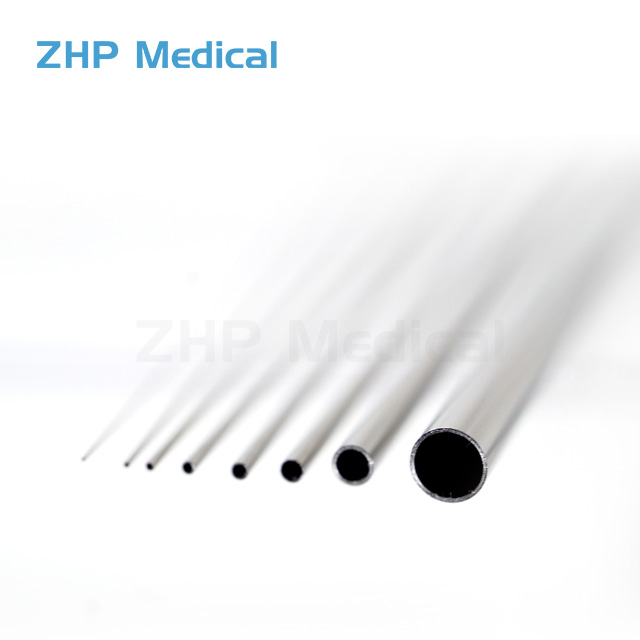
Hypotubes are generally drawn to standard gauge sizes with standard dimensional tolerances. They provide a reliable, highly flexible, and kink-resistant conduit for various medical instruments. Ideal applications include delivery systems, endoscopic guide tubes, and structural components where extreme microscopic precision in wall thickness is less critical to the device's primary function. The drawing process for hypotubes often utilizes a floating plug or no plug at all, which keeps manufacturing speeds high but allows for slight variations in the inner diameter.
Because they are manufactured to standard specifications and often stocked in common sizes, hypotubes offer significant cost efficiencies and shorter procurement lead times. They serve as excellent outer sheaths or pushers where torque transmission and navigation through tortuous anatomy are prioritized over the creation of microscopic, laser-cut features. For tools that do not remain implanted in the body, standard hypotubes provide an excellent balance of performance and availability.
Precision tubing is custom-drawn to exact Outer Diameter (OD) and Inner Diameter (ID) specifications with ultra-tight tolerances. This level of rigorous dimensional control is mandatory for manufacturing complex, laser-cut implants. Ideal applications include neurovascular stents, flow diverters, and micro-implants requiring perfectly uniform expansion rates. When a laser cuts a delicate stent pattern, any variation in wall thickness directly results in uneven strut widths.
Uneven struts lead to asymmetrical expansion, compromised radial force, and localized stress concentrations that severely degrade fatigue life. Precision drawing processes utilize specialized fixed mandrels and highly controlled drawing dies to ensure the concentricity and dimensional stability required for these critical applications. The tight tolerances ensure that every strut absorbs and distributes stress evenly across the entire implant structure.
Choosing between precision tubing and standard hypotubes depends on device requirements, cost, and manufacturing risk. Hypotubes may offer lower upfront costs and faster prototyping, but dimensional variations can increase scrap rates in high-precision applications. Custom precision tubing requires longer lead times and early supplier planning, but for permanent implants, it provides better consistency, reduces downstream manufacturing risks, and supports regulatory compliance.
Feature | Standard Nitinol Hypotube | Precision Nitinol Tubing |
|---|---|---|
Dimensional Tolerance | Standard gauge tolerances (moderate) | Ultra-tight custom tolerances (high) |
Concentricity | Variable, acceptable for sheaths | Highly uniform, required for stents |
Drawing Method | Floating plug or sink drawing | Fixed hard mandrel drawing |
Primary Use Case | Delivery catheters, pushers, guide tubes | Laser-cut implants, neurovascular stents |
Standard medical-grade Nitinol contains about 50.8 atomic% nickel, and even small changes in the Ni/Ti ratio can significantly affect the Af temperature and mechanical properties. Selecting the correct Af ensures reliable superelastic performance at body temperature. Ternary alloys can further enhance specific properties: NiTiCo improves stiffness and pushability for guidewires, while NiTiPt or palladium-containing alloys improve radiopacity, making devices easier to see under fluoroscopy without bulky marker bands.
Wall thickness uniformity, commonly referred to as concentricity, is the most critical metric for laser-cut stents to ensure even expansion and prevent weak points. Concentricity measures how perfectly centered the inner diameter is relative to the outer diameter. Manufacturing constraints dictate that wall thickness must typically maintain a specific ratio relative to the outer diameter to ensure drawing stability over the mandrel.
Generally, wall thickness should be greater than 10% of the OD. Pushing beyond these limits increases the risk of drawing fractures, severe eccentricity, or internal surface defects. Top-tier material suppliers provide standard tolerance ranges and length limitations when specifying ultra-thin walls. For highly critical applications, suppliers can hold tolerances as tight as ±0.0005 inches on critical dimensions, ensuring the laser cutting process yields highly consistent strut geometries.
The surface condition of the raw material impacts both manufacturability and final device performance. Standard surface conditions include light oxide (amber or blue), dark oxide, centerless ground, and mechanically polished. A dark oxide layer is highly abrasive and can accelerate wear on cutting tools or guide catheters. However, dark oxide absorbs laser energy exceptionally well, which can increase cutting speeds during initial machining.
Centerless grinding removes the outer oxide layer entirely, providing a precise OD and a clean, uniform surface for further processing. The inner diameter (ID) surface finish directly impacts the passage of guidewires or fluids through the device. A rough ID increases friction, hindering the smooth delivery of internal components. Specifying a smooth ID finish is critical for delivery catheters and sheaths that must navigate complex vascular pathways without snagging.
The initial conversion of solid rods or ingots into hollow tubes introduces baseline stresses that remain in the material. This process typically involves deep-hole gun-drilling of a solid billet, followed by multi-pass drawing over a hardened mandrel. Understanding this origin helps predict inclusion distribution and structural integrity. As the material is drawn down through successive dies, any non-metallic inclusions (like titanium carbides or oxides) are elongated along the drawing axis.
These elongated stringer inclusions can become initiation sites for fatigue cracks if they align unfavorably with the device's stress points. Recognizing the drawing history allows engineers to align the device's principal stress axes with the material's strongest orientation. Furthermore, intermediate annealing steps during the drawing process dictate the final grain size, which heavily influences the material's fatigue life and superelastic plateau.
Laser-machining requires strict control over energy input to prevent metallurgical damage. Wall thickness and concentricity directly affect laser focus and cutting speed. If the wall thickness varies, the laser may fail to penetrate the thicker sections, leaving uncut material, or over-penetrate and damage the opposite wall (known as back-wall dross). Strategies to minimize the Heat Affected Zone (HAZ) are critical to preserve the superelastic properties of the nitinol tube.
Using femtosecond or picosecond ultrashort pulse lasers reduces thermal damage compared to traditional continuous-wave fiber lasers. A large HAZ alters the local transformation temperature, creates brittle areas prone to fracture, and leaves a thick recast layer that must be aggressively removed. Controlling the HAZ during the initial cutting phase significantly reduces the time and aggressive chemicals required during subsequent electropolishing steps.
Optimize laser pulse width to ensure cold ablation rather than thermal melting.
Implement continuous assist gas flow (typically argon or oxygen) to clear molten slag immediately.
Design cutting paths that distribute heat evenly across the tube circumference to prevent localized warping.
Perform immediate post-cut ultrasonic cleaning to remove loose dross before it hardens.
Expanding a smaller tube to a larger functional diameter involves strict expansion ratios and precise thermal control. Leveraging the unique properties of a nitinol tube allows engineers to utilize a smaller starting profile that can be expanded further and bent more aggressively than traditional metals like stainless steel or cobalt-chromium. This capability is foundational for modern transcatheter technologies.
The tube's initial cold work and drawing history impact its response to shape-setting heat treatments. High amounts of retained cold work require specific time and temperature profiles (typically between 450°C and 550°C) to achieve the desired shape memory effect without causing excessive grain growth. Utilizing fluidized beds or molten salt baths ensures rapid, uniform heat transfer, which is critical for maintaining consistent Af temperatures across the entire length of the device.
Common failure modes during tube expansion and crimping include strut fracture and hinge-point micro-cracking. These failures often stem from exceeding the material's local strain limits during shape setting or from pre-existing surface defects acting as stress multipliers. You must implement strict inspection protocols to detect anomalies before value-added processing begins.
Scanning Electron Microscopy (SEM) analysis and eddy current testing are highly effective methods for identifying inclusions, voids, or drawing defects in the raw material. Catching these microscopic flaws at the raw material stage prevents expensive scrap after laser cutting and shape setting have already been performed. Post-processing steps, such as automated electropolishing, are also mandatory to smooth out micro-cracks and remove the brittle recast layer left by laser cutting.
Regulatory bodies require strict adherence to established material standards to ensure patient safety. ASTM F2063 mandates the chemical composition, inclusion limits, and mechanical property requirements for wrought nickel-titanium shape memory alloys used in medical devices. It specifies maximum allowable limits for carbon (typically 0.050% max) and oxygen (typically 0.050% max), as well as strict limits on trace elements.
Non-compliant tubing introduces unacceptable regulatory risk, leading to rejected FDA 510(k) or PMA submissions. High carbon or oxygen content leads to excessive carbide and oxide inclusions, which devastate fatigue life. Ensuring the raw material meets these baseline requirements is the absolute foundation of device safety and efficacy. Material certifications must be scrutinized to ensure every lot meets these exacting standards.
Raw material must undergo rigorous post-processing surface treatments to ensure long-term biocompatibility. Electropolishing and chemical passivation (often using nitric acid) are necessary to remove the heat-affected zone, smooth the surface, and create a highly protective, nickel-free titanium dioxide (TiO2) layer. This robust oxide layer acts as a barrier, preventing toxic nickel ions from leaching into the bloodstream.
Standard testing protocols, such as ASTM F2129 for pitting corrosion, validate the integrity of this protective layer. Devices must demonstrate that they can withstand the highly corrosive, saline environment of the human body without breaking down or releasing heavy metals. A poorly processed surface will fail corrosion testing, halting the regulatory approval process entirely.
Establish stringent criteria for evaluating and auditing suppliers. Ingot traceability, drawing process control, and certified material test reports (CMTRs) are mandatory for medical device manufacturing. Lot-to-lot consistency ensures that a validated manufacturing process does not suddenly produce failing parts due to unexpected raw material variations.
Evaluate the supplier's quality management system to confirm they maintain rigorous control over their drawing dies, annealing temperatures, and inspection equipment. A reliable supplier will provide comprehensive documentation tracking the material from the original melted ingot down to the final drawn tube, ensuring complete transparency and traceability for regulatory audits.
Engage with material scientists or contract manufacturing partners early in the design phase to lock in specifications before freezing the device design.
Request and review Certified Material Test Reports (CMTRs) to verify strict ASTM F2063 compliance and acceptable inclusion limits.
Conduct prototype laser cutting and shape setting on multiple material lots to validate process capability and identify potential heat-affected zone issues early.
Establish clear incoming inspection protocols, including eddy current testing and dimensional verification, to catch defects before value-added manufacturing begins.
A: Hypotubes are drawn to standard gauge sizes with standard tolerances, making them efficient for delivery systems and guide tubes. Precision tubing is custom-drawn to exact outer and inner diameter specifications with ultra-tight tolerances. This precision is required for laser-cut implants like stents to ensure uniform wall thickness and symmetrical expansion.
A: The Active Austenitic Finish (Af) temperature dictates when the alloy fully transitions into its superelastic state. For medical implants, the Af temperature must be set below human body temperature (37°C). This ensures the device exerts continuous outward radial force and recovers its shape after being deployed from a catheter.
A: Starting with a strategically smaller diameter allows engineers to maximize the material's superelastic properties. A smaller starting profile fits into lower-profile delivery catheters. Through thermomechanical shape setting, the material can be expanded to a much larger functional diameter while retaining the ability to bend aggressively through tortuous vascular anatomy.
A: Standard surface finishes include light oxide (amber or blue), dark oxide, centerless ground, and mechanically polished. Oxide layers can be abrasive but absorb laser energy well during machining. Centerless grinding provides a precise outer diameter and removes oxides. The inner diameter finish is also critical for ensuring the smooth passage of guidewires.
A: Concentricity measures the uniformity of the wall thickness. When laser cutting a stent, poor concentricity results in uneven strut widths. Uneven struts cause asymmetrical expansion, localized stress concentrations, and reduced radial force, which drastically increases the risk of fatigue failure and micro-cracking during millions of cardiac cycles.
A: The maximum safe expansion rate depends on the alloy's initial cold work, drawing history, and wall thickness. While the material can undergo significant deformation, over-expanding a small tube can thin the struts excessively or induce micro-cracking. Expansion must be done in controlled, incremental heat-treatment steps to preserve structural integrity.